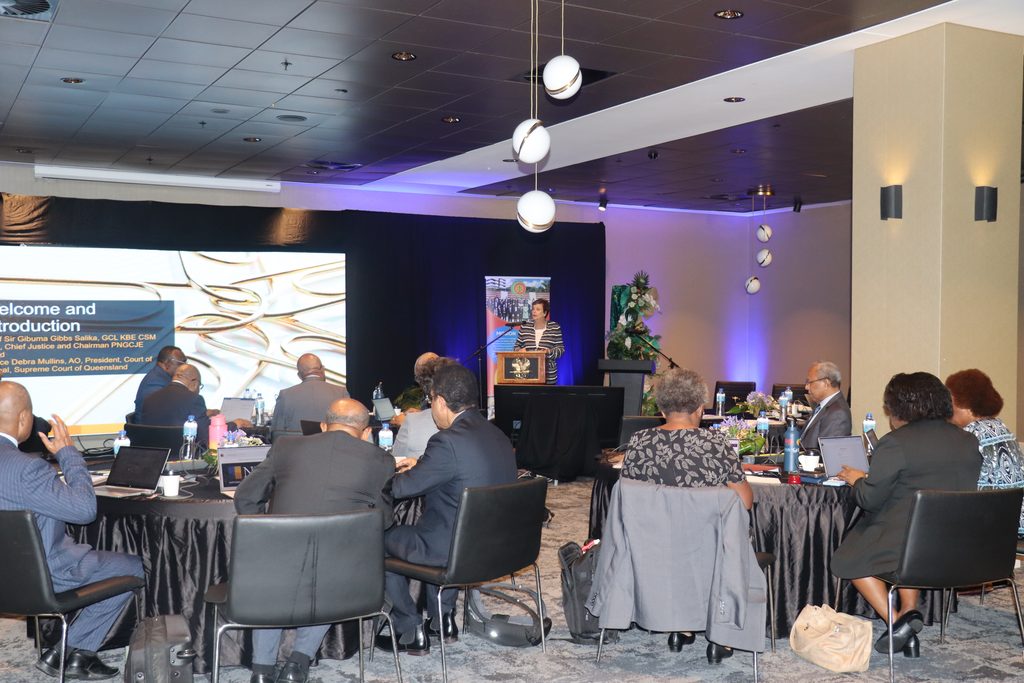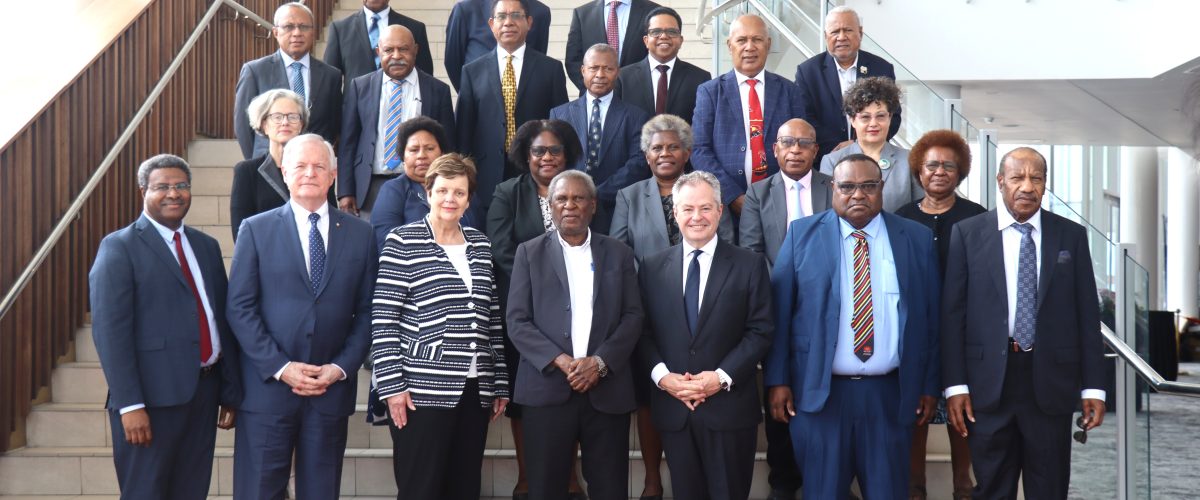
The Appellate Judgment Writing Workshop, a joint judicial education initiative delivered through a partnership between the Papua New Guinea Centre for Judicial Excellence (PNGCJE) and the National Judicial College of Australia (NJCA), concluded today after bringing together Justices of the National and Supreme Courts of Papua New Guinea and distinguished judicial educators from Australia to advance appellate adjudication, judicial reasoning, and judgment-writing practices.
Held at APEC Haus from 29 to 30 October 2026, the workshop focused on improving the quality, consistency and effectiveness of appellate decision-making through specialised training and judicial deliberation.
Chief Justice Sir Gibuma Gibbs Salika, GCL, KBE, CSM, OBE, officially opened the workshop, emphasising the critical role appellate courts play in shaping Papua New Guinea’s legal and constitutional framework and maintaining public confidence in the administration of justice.
“The decisions of our appellate courts shape the legal and democratic landscape of Papua New Guinea. What we write today becomes the guidance for judges tomorrow, the reference point for legal practitioners, and often the authoritative statement of the law for government institutions and the wider community,” the Chief Justice said.
The Chief Justice acknowledged the participation of Australian judicial educators Justice Debra Mullins AO, President of the Court of Appeal of the Supreme Court of Queensland; Justice Mark Livesey, President of the Court of Appeal of the Supreme Court of South Australia; Justice Glenn Martin of the Supreme Court of Queensland; and Karen Gregory, Chief Executive Officer of the National Judicial College of Australia. He also acknowledged the contributions of Papua New Guinea’s own Justice Colin Kenway Makail and Justice Vergil Los Narokobi, who participated as presenters and discussants throughout the workshop.
Sir Gibuma also expressed appreciation to the PNGCJE and the NJCA for their continued commitment to judicial education and professional development, describing the long-standing partnership as a reflection of a shared dedication to judicial independence, judicial excellence and the rule of law.
During the workshop, participants explored a range of specialised topics designed to strengthen appellate judicial practice, including appeal preparation, judicial deliberations, appellate and review jurisdiction, constitutional references and applications, the drafting of short and complex
judgments, concurring and dissenting judgments, and strategies for addressing challenges in appellate decision-making. The sessions focused on enhancing the quality, clarity, consistency and timeliness of judgments delivered by Papua New Guinea’s appellate courts.
In her opening remarks, Justice Debra Mullins AO highlighted the significance of delivering the workshop in Papua New Guinea only five months after the National Judicial College of Australia’s inaugural Appellate Judgment Writing Program was conducted in Sydney in June 2026.
Justice Mullins noted that Justice Makail and Justice Narokobi had attended the Sydney program and were instrumental in advocating for its delivery in Papua New Guinea.
“I did not realise it would happen so quickly, but through the efforts of all involved, we have been able to organise the program and present it in Papua New Guinea within just five months of the inaugural course in Sydney,” Justice Mullins said.
Justice Mullins said appellate judgment writing is a specialised area of judicial work that requires a distinct approach because of the unique responsibilities of appellate courts.
“The sessions have been specifically designed to address the sequential steps involved in the preparation, hearing and determination of appeals, with a particular focus on the task of appellate judgment writing,” Justice Mullins said.
A key feature of the workshop was its interactive format, encouraging participating judges to share experiences, engage in discussion, and explore practical challenges facing appellate courts. Discussions included strategies for reducing judicial delay, handling complex appeals, writing concurring and dissenting judgments, and strengthening constitutional adjudication practices.
The two-day workshop provided participating judges with a valuable forum to exchange perspectives, examine contemporary appellate practices and further strengthen the quality and effectiveness of appellate justice in Papua New Guinea.