
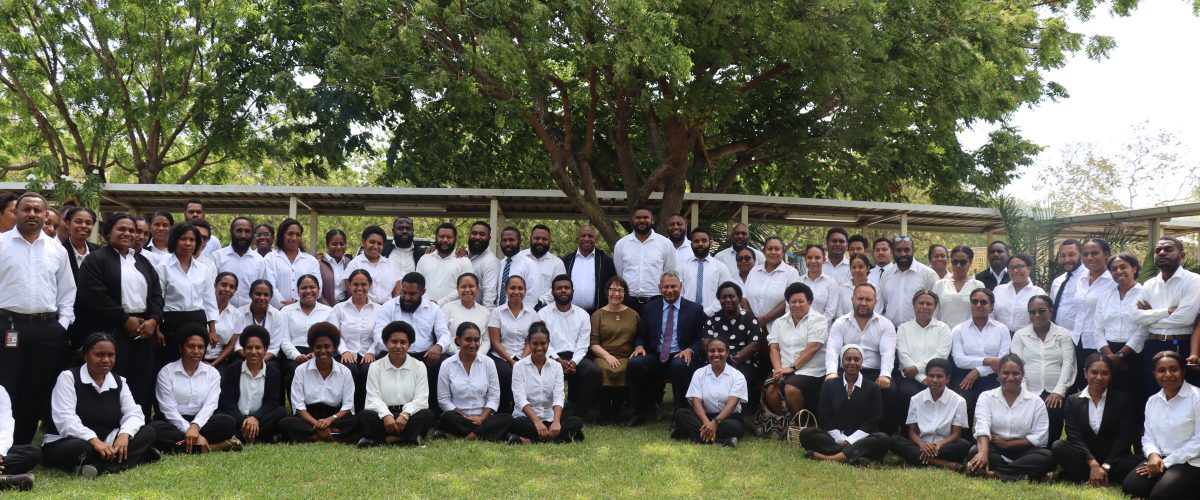
Aspiring trainee lawyers at the Legal Training Institute (LTI) recently attended a guest lecture organised by the Papua New Guinea Centre for Judicial Excellence (PNGCJE), featuring Justice Darryl Rangiah of the Federal Court of Australia, who presented on the topic, “Seven Ways to Be a Great Advocate.”
Participants were warmly welcomed to the session, which formed part of PNGCJE’s ongoing efforts to strengthen advocacy skills among Papua New Guinea’s emerging legal professionals.
Justice Rangiah delivered the presentation drawing on more than three decades of legal experience as a barrister, Queen’s Counsel and judge. The session provided practical insights into what judges look for in advocates appearing before the courts and highlighted the essential qualities required to become an effective and persuasive lawyer.
Appointed to the Federal Court of Australia in 2013, Justice Rangiah also serves on the Supreme Court of the Australian Capital Territory. Prior to his judicial appointment, he practised at the Queensland Bar and was appointed Queen’s Counsel in 2008. He currently serves as the National Coordinating Judge for the Employment and Industrial Relations Practice Area within the Federal Court and is Vice-President of the Australian Judicial Officers Association.
Addressing participants, Justice Rangiah reflected on his professional journey from South Africa to Australia and encouraged aspiring lawyers to embrace every opportunity to learn from experienced practitioners and judicial officers.
A central theme of the presentation was that advocacy is fundamentally the art of persuasion. Justice Rangiah emphasised that successful advocates must communicate clearly, accurately and efficiently.
“The importance of accuracy cannot be overstated,” Justice Rangiah said. “Every submission made to a court should be capable of being supported by evidence or authority. Advocates should avoid exaggeration and instead present their case with precision and credibility.”
Justice Rangiah advised participants that written submissions should complement, rather than replace, oral advocacy. While written submissions assist judges in understanding the issues before the court, he emphasised that oral advocacy remains the primary opportunity to persuade a judge.
He also urged future lawyers to identify the issues in dispute clearly and at an early stage of proceedings, helping judges focus on the matters that require determination.
Drawing on his experience on the bench, Justice Rangiah highlighted the importance of preparation, particularly in cross-examination. He encouraged advocates to plan their questioning carefully, remain focused on relevant issues and ensure that every question serves a clear purpose.
“Preparation is critical,” Justice Rangiah said. “Cross-examination is a skill that can be developed through practice, experience and thoughtful preparation.”
Justice Rangiah further stressed the importance of responding directly to judicial questions, noting that effective advocates engage openly with the court and provide clear, honest answers, even when additional time is needed to research a particular point.
The session provided participants with a valuable opportunity to gain direct insight from a senior judicial officer and to better understand the expectations of the judiciary in both civil and criminal proceedings.
Ms Angelyn Paranda Director Legal Training Institute in her closing remarks, acknowledged the contribution of Justice Rangiah, noting that engagements with experienced international judicial officers provide invaluable learning opportunities for Papua New Guinea’s next generation of legal practitioners and strengthen the country’s commitment to professional excellence within the justice sector.
Ms Paranda also thanked the Papua New Guinea Centre for Judicial Excellence for organising guest lectures that expose aspiring lawyers to the practical experiences and perspectives of distinguished members of the judiciary.
“Such engagements help bridge the gap between legal education and practice while inspiring future lawyers to pursue excellence in the profession,” she said.