
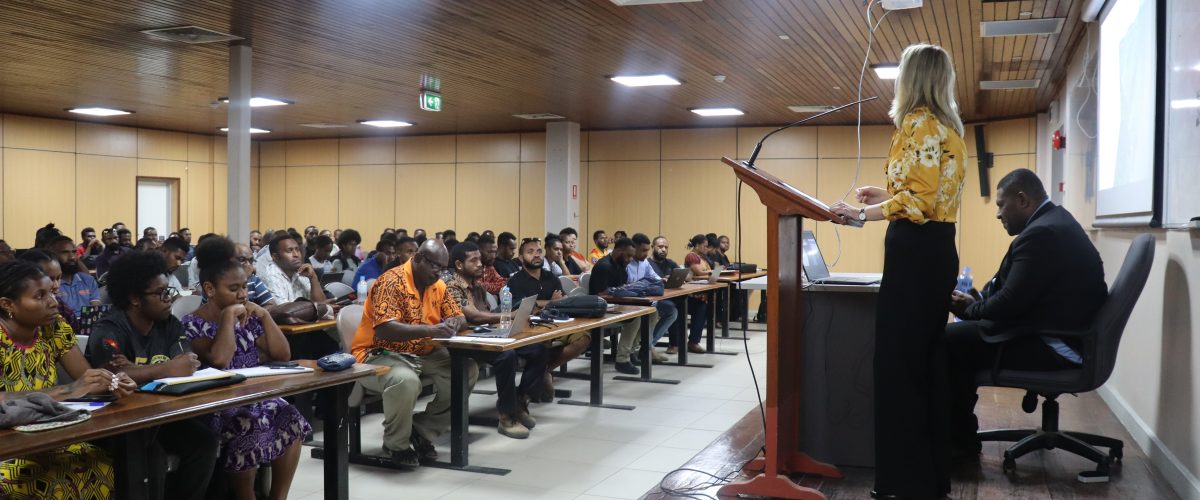
The growing threat of environmental crime in Papua New Guinea requires more than traditional law enforcement measures. Effective financial investigations, asset recovery, and anti-money laundering laws are increasingly recognised as powerful tools in disrupting criminal networks that profit from the illegal exploitation of natural resources. This was the key message delivered by Justice Teresa Berrigan of the Supreme and National Courts of Papua New Guinea during a guest lecture to law students and legal professionals at the University of Papua New Guinea (UPNG) School of Law, where she explored the role of anti-money laundering legislation in combating environmental crime and safeguarding the nation’s natural heritage.
Justice Berrigan examined the links between environmental crime, corruption, organised crime and money laundering, and outlined how Papua New Guinea’s legal framework could be used to disrupt illicit profits derived from environmental offences.
Addressing participants, Justice Berrigan noted that environmental crime is among the most profitable forms of transnational crime globally.
“Environmental crime is one of the world’s fastest-growing and most lucrative illegal activities, surpassed only by drug trafficking, counterfeiting and human trafficking. The ecological damage caused by these crimes has potentially devastating consequences for the entire globe – through biodiversity loss, pollution and climate change pressures. For individual nation states, environmental crime depletes government revenues through tax evasion and undermines legitimate and sustainable industries,” Justice Berrigan said.
Her Honour stressed that addressing environmental crime is particularly important for Papua New Guinea, given the country’s rich natural resources and unique biodiversity.
“Papua New Guinea is blessed with vast natural resources that are highly sought after – from under its land to its tropical rainforests, rivers and rich marine reefs. These resources are critical not only to its economy but to its people and their way of life. ” Her Honour said.
Justice Berrigan explained that while prosecuting environmental offences remains important, traditional enforcement approaches often focus on individuals directly involved in the illegal activity while failing to target those who profit most from them.
“Too often, penalties are low when compared to the scale of the damage caused and the profits generated. This approach may punish those at the lower end of offending but does little to dismantle the business model that enables environmental crime to continue,” Her Honour said.
During the lecture, Justice Berrigan outlined how Papua New Guinea’s Proceeds of Crime Act and provisions of the Criminal Code can be used to recover illicit assets, restrain criminal property and prosecute money laundering offences connected to environmental crimes.
Her Honour explained that anti-money laundering laws provide authorities with the ability to pursue not only the perpetrators of environmental offences but also those who facilitate, conceal or benefit from criminal conduct.
“By stripping offenders of their profits and penalising those who enable them, authorities can recover illicit gains and remove both the means and motivation for future criminal activity,” Justice Berrigan said.
Her Honour also highlighted Papua New Guinea’s constitutional responsibility to ensure that the country’s natural resources are used for the collective benefit of its people.
“The Constitution of Papua New Guinea recognises the connection between development and conservation. It expressly declares that the country’s resources shall be used for the collective benefit of the country and its future generations.”
In concluding her presentation, Justice Berrigan encouraged future lawyers and legal practitioners to recognise the growing importance of anti-money laundering laws in addressing environmental offending.
Justice Berrigan’s lecture formed part of ongoing efforts to strengthen legal understanding of emerging challenges facing Papua New Guinea and the wider region. By highlighting the intersection of environmental crime, organised crime, corruption and money laundering, Her Honour underscored the important role that future lawyers, prosecutors, judges and legal practitioners will play in maintaining the environmental rule of law. The lecture provided participants with valuable insights into the use of anti-money laundering laws and asset recovery measures to protect Papua New Guinea’s natural resources, uphold the rule of law, and safeguard the nation’s environmental future for generations to come.