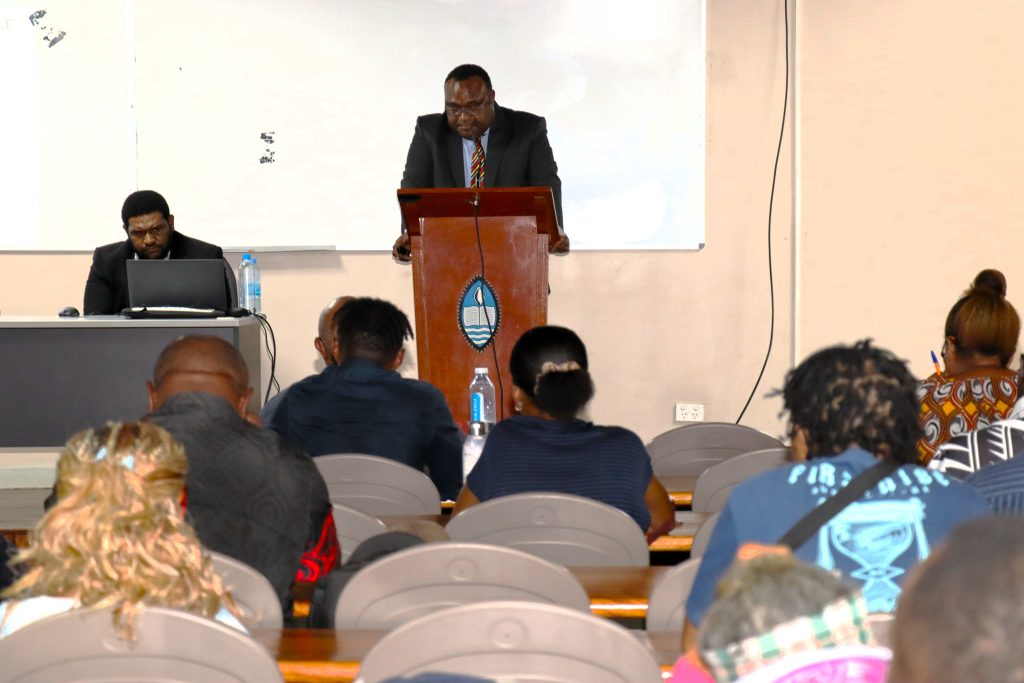
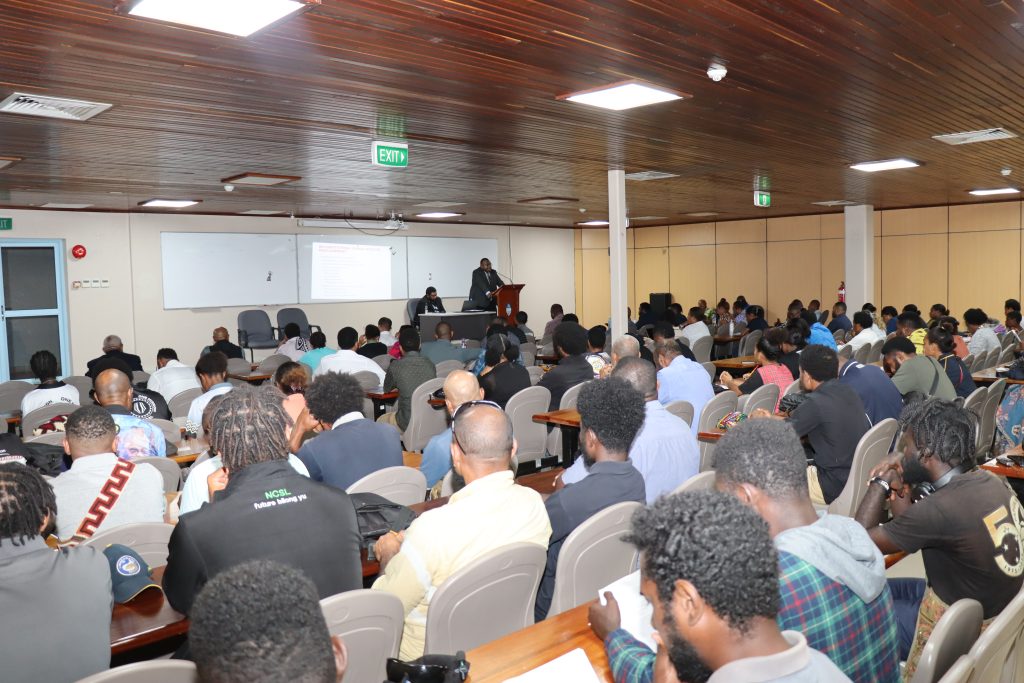
The University of Papua New Guinea (UPNG) School of Law, in partnership with the Papua New Guinea Centre for Judicial Excellence (PNGCJE), recently hosted a distinguished lecture by Justice Vergil Narokobi, Judge of the National and Supreme Court. The lecture focused on the constitutional challenges surrounding Bougainville’s political future.
Justice Narokobi emphasized that his remarks were delivered in a personal and academic capacity and did not represent the views of the Government of Papua New Guinea or the judiciary. His presentation, originally published by the University of Texas, explored the constitutional implications of Bougainville’s 2019 referendum, in which 97.7% of Bougainvilleans voted for independence.
“The referendum emanated from the peace agreement following the decade-long civil war, but the current negotiations between the National Government and the Autonomous Bougainville Government (ABG) raise profound constitutional questions,” Justice Narokobi stated. “If Bougainville were to unilaterally declare independence without proper constitutional process, it could undermine Papua New Guinea’s Constitution and challenge the unity of the nation.”
Justice Narokobi outlined three major constitutional developments since the 2001 Peace Agreement:
- Amendments to the PNG Constitution introducing Part XIV, which established Bougainville’s governance framework and referendum provisions
- The Organic Law on Peacebuilding in Bougainville, which created mechanisms for transferring powers from the National Government to Bougainville
- The Bougainville Constitution (2004), which defined Bougainville’s governance structure and entrenched autonomy.
He highlighted Section 342 of the Constitution as a critical area of uncertainty, noting that while it requires consultation and parliamentary ratification of the referendum results, it does not prescribe the form or majority required for Parliament’s decision.
The 2022 Era Kone Covenant between the National Government and the ABG seeks to address this gap by committing Parliament to consider and decide on the referendum outcome between 2025 and 2027.
Justice Narokobi cautioned that failure to resolve these constitutional uncertainties could lead Bougainville to pursue a unilateral declaration of independence, potentially seeking international recognition. “Constitutions are created to resolve tensions,” he remarked. “It is imperative that Papua New Guinea addresses Bougainville’s aspirations within the constitutional framework to avoid destabilizing the nation’s unity.”
The lecture concluded with a lively question-and-answer session, during which students and faculty engaged Justice Narokobi on the constitutional role of Parliament, the function of the courts, and the possible need for constitutional amendments to accommodate Bougainville’s independence aspirations.