
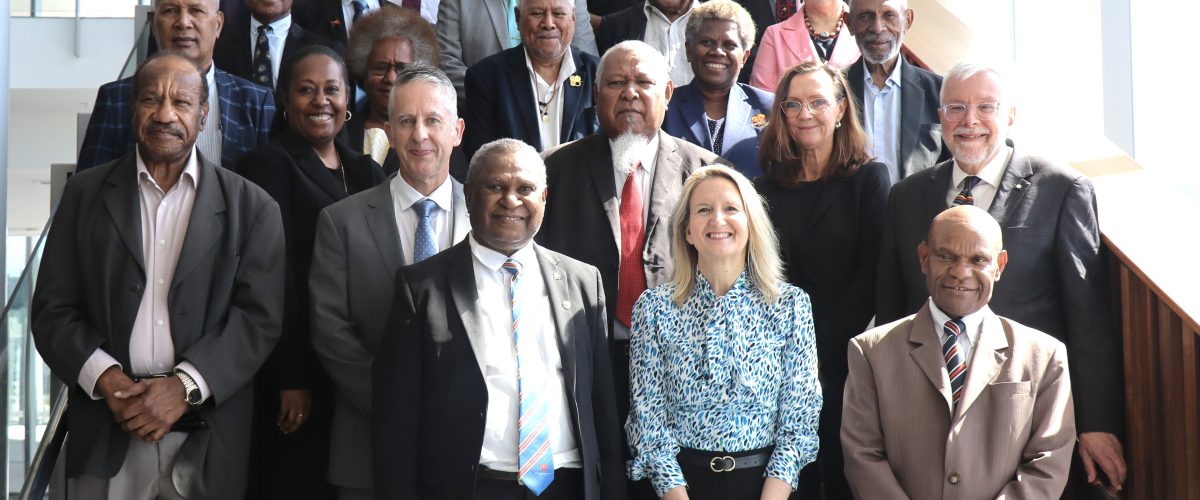
Thirty-two judges from the Supreme and National Courts of Papua New Guinea are participating in a two-day workshop on Environmental Law and Practice from the 17 – 18 August in Port Moresby.
The workshop brings together judges, legal experts, and facilitators from Papua New Guinea, Australia, and Indonesia to enhance judicial understanding of environmental law and strengthen the courts’ capacity to address increasingly complex environmental disputes.
Opening the workshop, Chief Justice of Papua New Guinea, Sir Gibuma Gibbs Salika GCL, KBE, CSM, OBE, reflected on the central role of the environment in the lives of Papua New Guineans, particularly those living in rural communities. He also underscored the growing importance of environmental law and the critical role of the judiciary in addressing environmental challenges while supporting sustainable development.
“For many Papua New Guineans, the environment is not an abstract concept. It is our home, our source of food, our livelihood, and our way of life,” he said, noting the close relationship between people, land, rivers, forests, and natural resources.
Chief Justice Salika welcomed judges, legal professionals, facilitators, and environmental law experts from Papua New Guinea, Australia, and Indonesia to the workshop, highlighting its importance in strengthening judicial understanding of environmental law and dispute resolution.
The Chief Justice began by acknowledging the Motu Koita people as the traditional custodians of the land on which the workshop is being held and paid his respects to their elders past and present, recognising their enduring connection to the land and environment.
He also acknowledged the leadership of Deputy Chief Justice Ambeng Kandakasi and Justice Derek Wood in organising the workshop and thanked Professor Amanda Kennedy, Head of the School of Law at the Queensland University of Technology in Brisbane, for her contribution as a key facilitator. He commended the organisers for developing a comprehensive program and bringing together an impressive team of local and international experts.
The workshop reflects the Judiciary’s commitment to continuing judicial education and professional development. Chief Justice Salika said the participation of international experts demonstrated the value of judicial cooperation and a shared commitment to advancing environmental justice across the region.
Speaking on the significance of environmental law, the Chief Justice noted that Papua New Guinea’s rich biodiversity, abundant natural resources, and extensive customary land ownership present both opportunities and challenges for the nation.
“As a nation blessed with abundant natural resources, rich biodiversity and extensive customary land ownership, we face unique opportunities and challenges in balancing sustainable development, environmental protection and the interests of our people,” he said.
He emphasised that the courts have an increasingly important responsibility in resolving disputes involving land, mining, forestry, fisheries, pollution, conservation, and community rights, matters that often involve complex legal, scientific, technical, and social considerations.
The two-day training program has been designed to provide participants with practical and specialised knowledge in environmental law and practice. Sessions on the first day include Environmental Justice in a Rapidly Changing PNG, Foundations of Environmental Law in PNG, Proceeds of Crime and Money Laundering in the Context of Environmental Law, Access to Justice in Environmental Cases, Adapting Practice and Procedure for Environmental Cases, Evaluating Evidence in Environmental Cases, and practical exercises based on a hypothetical environmental case.
Presenters on the opening day include Deputy Chief Justice Ambeng Kandakasi, Chief Judge Brian Preston, Justice Derek Wood, Justice Berrigan, Senior Commissioner Susan Dixon, and Professor Amanda Kennedy.
The second day of the workshop will focus on Remedies and Sanctions in Environmental Cases, Alternative Dispute Resolution of Environmental Disputes, Adjudicating Environmental Disputes, and The Craft of Giving Judgment. Participants will also receive comparative insights into Indonesia’s judicial approach to environmental disputes from Justice Bambang H. Mulyono and take part in practical exercises designed to strengthen judicial decision-making in environmental matters.
Chief Judge Brian Preston, a leading authority in environmental jurisprudence, is facilitating a number of key sessions throughout the workshop, including access to justice, environmental adjudication, environmental remedies and sanctions, and judgment writing. The program also incorporates practical exercises and discussions aimed at enhancing judicial effectiveness and improving outcomes in environmental cases.
Chief Justice Salika stressed that the workshop is more than an academic exercise and will play an important role in strengthening the ability of Papua New Guinea’s courts to respond effectively to the increasing number and complexity of environmental disputes.
“The knowledge and experience shared during this workshop will assist us in strengthening our courts and enhancing our ability to deal effectively with environmental disputes that increasingly come before us,” he said.
He encouraged participants to actively engage in discussions, exchange experiences, and make full use of the expertise available throughout the training, noting that some of the most valuable lessons in judicial education come through professional dialogue and shared learning.
On behalf of the Judiciary of Papua New Guinea, Chief Justice Salika expressed his appreciation to all facilitators, presenters, and organisers for their contribution to the workshop and wished participants a productive, insightful, and successful training.