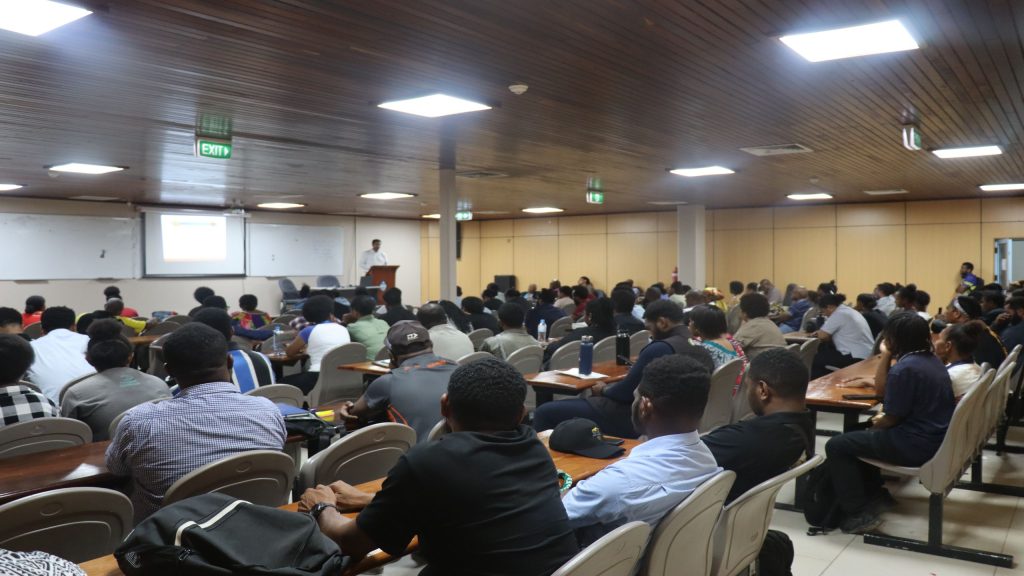
Law students at the University of Papua New Guinea (UPNG) School of Law have been encouraged to broaden their vision of legal careers beyond traditional legal practice and consider judicial education as a vital and emerging field that strengthens the justice system and promotes access to justice.
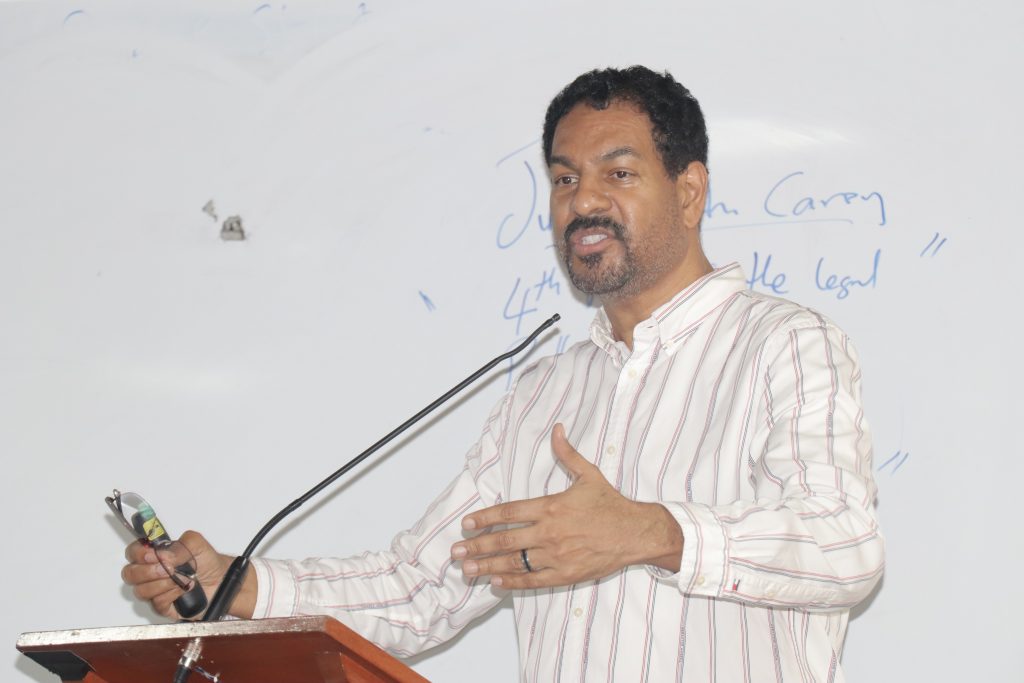
Delivering a lecture to students and faculty at the UPNG School of Law, Justice John Carey, Judge Administrator and Executive Director of the Papua New Guinea Centre for Judicial Excellence (PNGCJE), presented the proposition that judicial education should be recognised as the fourth pillar of the legal profession, alongside private legal practice, public sector law, and judicial service.
Addressing future lawyers and justice sector leaders, Justice Carey challenged students to consider the important role that learning, professional development, and institutional capacity building play in delivering justice and strengthening the rule of law.
“Most law students enter law school aspiring to become lawyers, prosecutors, or judges. Few consider becoming judicial educators. Yet judicial education plays a critical role in strengthening legal competency, promoting ethical standards, and improving access to justice throughout our country,” Justice Carey said.
Drawing on his own professional journey, Justice Carey explained that his path to the Bench was significantly influenced by his work in judicial education, demonstrating that legal careers can take many forms and that opportunities exist beyond conventional legal practice. He emphasised that judicial educators are responsible for developing and delivering training programmes for judges, magistrates, lawyers and court officers, ensuring that legal professionals continue to learn and adapt in an increasingly complex world.
The lecture highlighted the growing importance of lifelong learning within the legal profession. Justice Carey noted that modern judges face challenges far different from those encountered by previous generations, including increasing caseloads, rapidly evolving laws, digital technologies and the emergence of artificial intelligence. As a result, continuous
professional development is essential to maintaining judicial competence and public confidence in the justice system.
A significant focus of the presentation was the work of the Papua New Guinea Centre for Judicial Excellence (PNGCJE). Justice Carey outlined how the Centre, established in 2010, has become a leading institution for judicial education and professional development in Papua New Guinea and across the Pacific region. Guided by representatives from the judiciary, magisterial services, legal education institutions, the Law Society and key justice sector agencies, PNGCJE develops and delivers training programmes designed to strengthen the capacity and competency of justice sector stakeholders.
Justice Carey informed students that PNGCJE conducts approximately 140 training activities annually, covering judicial ethics, professional conduct, emerging legal issues, specialised areas of law, judicial wellbeing, leadership development and access to justice initiatives. He explained that the Centre is increasingly adopting competency-based approaches to training, enabling measurable improvements in professional performance and service delivery.
“At PNGCJE, our goal is not simply to conduct training activities. Our focus is on improving competency and professional standards so that justice sector institutions can better serve the people of Papua New Guinea,” Justice Carey said.
Justice Carey also discussed the growing impact of technology and artificial intelligence on courts and legal practice. He noted that Papua New Guinea’s courts are increasingly using electronic case management systems and digital processes, making technological literacy an important component of modern legal practice. He stressed that judicial education has a critical role in preparing judges, lawyers and court officials to embrace innovation responsibly while maintaining professional and ethical standards.
The Judge Administrator further encouraged students to view judicial education as a meaningful career pathway, revealing that PNGCJE is expanding its capacity and creating opportunities for lawyers to contribute to professional education, legal reform and institutional development both within Papua New Guinea and throughout the Pacific region.
“The future of our justice system depends on continuous learning, professional excellence and the commitment of the next generation of legal professionals. PNGCJE stands ready to support and develop those who are committed to serving justice and strengthening the rule of law,” Justice Carey said.
The lecture formed part of PNGCJE’s ongoing engagement with legal education institutions and reflects the Centre’s commitment to nurturing the next generation of legal professionals, judicial officers and leaders who will contribute to strengthening the rule of law and improving access to justice throughout Papua New Guinea and the Pacific.