
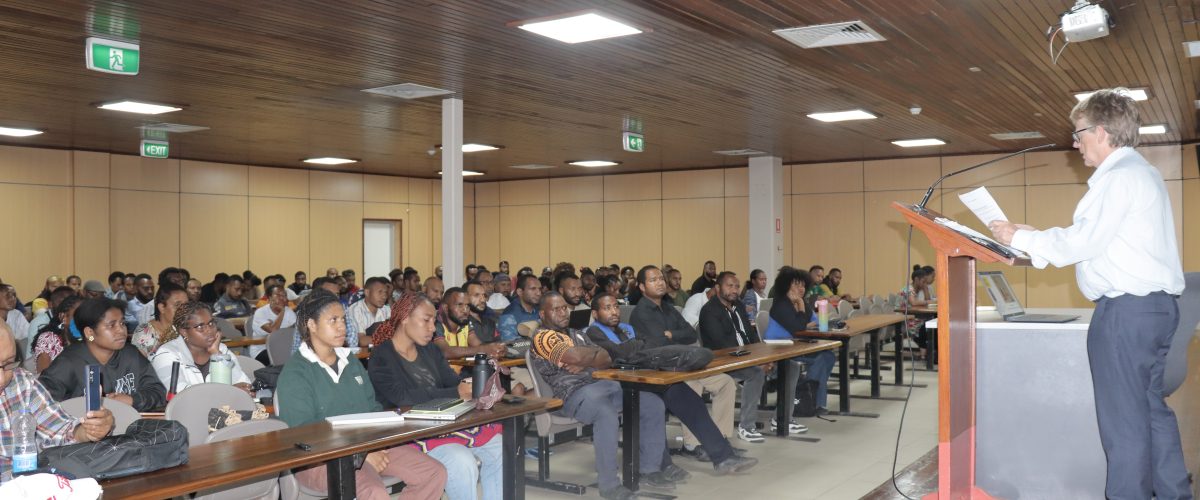
Students at the University of Papua New Guinea (UPNG) School of Law were privileged to attend a thought-provoking guest lecture delivered by distinguished legal academic and youth justice expert Dr Louis Schetzer on the topic,“Youth Justice: When Does a Child Develop Criminal Responsibility?”
Dr Schetzer is a Teaching Academic at the University of New South Wales Faculty of Law and Justice and the National Legal Research and Policy Manager at the Justice Reform Initiative. With more than three decades of experience in criminal law, youth justice, human rights, and legal reform, he is widely recognised for his contributions to legal scholarship, policy development, and justice sector reform across Australia and the region. He is currently undertaking research in Papua New Guinea on village courts and youth justice.
Welcoming the opportunity to engage with Papua New Guinean law students, Dr Schetzer expressed his appreciation for the warm reception he has received since arriving in the country several months ago.
“I would like to thank you on behalf of your country for the welcome that I have received over the last four months. It has been a phenomenal journey of learning and understanding. I have been like a sponge, absorbing different experiences and perspectives, particularly in learning about Papua New Guinea’s youth justice system and village courts, which I have found especially fascinating,” he said.
Before commencing his presentation, Dr Schetzer paid tribute to the late former Supreme Court Justice Ere Kariko, acknowledging his significant contribution to Papua New Guinea’s justice system.
“He was such an important and influential jurist in this country, and one cannot help but feel that the justice system is diminished by his passing. I acknowledge his enormous contribution to Papua New Guinea,” Dr Schetzer said.
The lecture explored one of the most significant and debated issues in criminal law and youth justice: the age at which a child should be held criminally responsible for their actions. Drawing on international legal developments, human rights standards, and comparative experiences from Australia, Papua New Guinea, and other jurisdictions, Dr Schetzer challenged students to critically examine how the law understands childhood, responsibility, and accountability.
In his presentation, Dr Schetzer encouraged students to reflect on their own childhood experiences and consider whether the mistakes and impulsive actions commonly associated with growing up should automatically result in a child being labelled a criminal.
As part of this discussion, he highlighted the importance of language and the harmful effects of stigma within the justice system.
“It is important that we recognise the human being behind the child rather than defining them solely by their alleged criminal conduct. If we want to divert children from the criminal justice system and encourage them to become positive members of their communities, we must recognise their potential rather than view them as inherently criminal,” he said.
Dr Schetzer examined the minimum age of criminal responsibility in Papua New Guinea and compared it with approaches adopted in other jurisdictions, noting that while Papua New Guinea currently sets the age at 10 years, many countries have moved towards a higher threshold. He also discussed recommendations of the United Nations Committee on the Rights of the Child, which encourages nations to raise the minimum age of criminal responsibility to at least 14 years.
The lecture further explored the common law doctrine of doli incapax, a legal principle that presumes children within a certain age range may lack the capacity to understand that their actions are seriously wrong unless proven otherwise. Dr Schetzer explained how the doctrine seeks to protect children from the most severe consequences of the criminal justice system by recognising their varying levels of intellectual, emotional, and moral development.
Throughout the session, students actively engaged in discussions on legal responsibility, maturity, child development, and the evolving nature of youth justice systems around the world. The lecture provided valuable comparative perspectives and encouraged critical thinking about the balance between accountability, rehabilitation, and the rights of children. The guest lecture formed part of the Papua New Guinea Centre for Judicial Excellence (PNGCJE) and UPNG School of Law Guest Lecture Series, which aims to expose students to contemporary legal issues and diverse professional perspectives. Through engagements with distinguished judges, academics, and legal practitioners, the programme continues to enrich legal education by connecting academic learning with practical experience and encouraging the next generation of legal professionals to engage critically with issues affecting the administration of justice