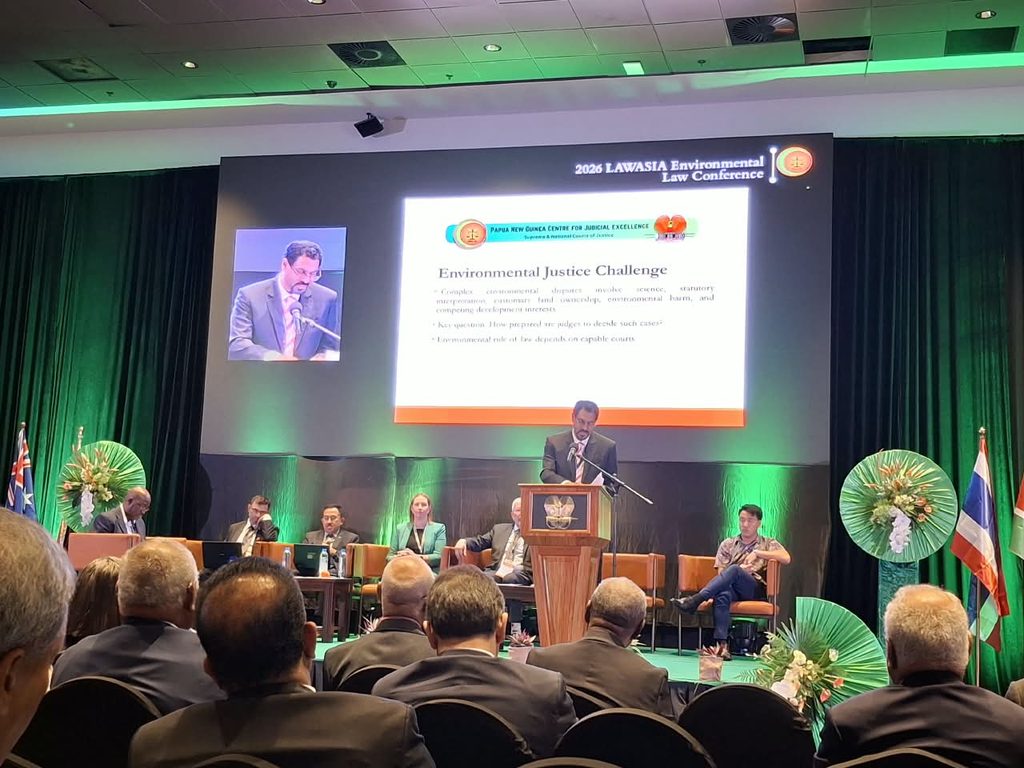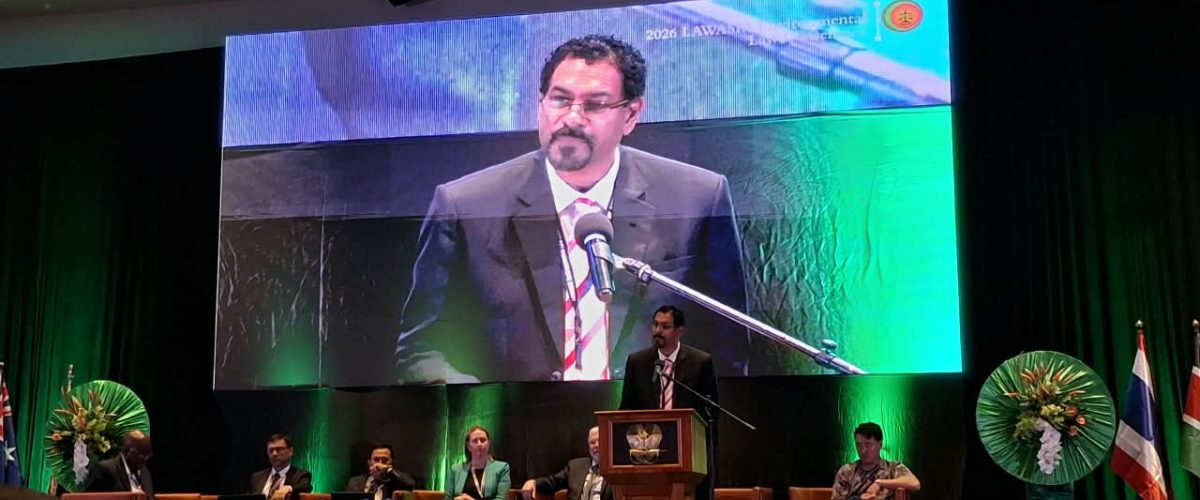
The need for continuous judicial education and regional cooperation in environmental law took centre stage at the LAWASIA Conference in Port Moresby, with Justice John G.F. Carey, Judge of the Supreme and National Courts of Papua New Guinea and Judge Administrator and Executive Director of the Papua New Guinea Centre for Judicial Excellence (PNGCJE), calling for a strategic and sustained approach to building judicial capacity across the Pacific.
Speaking during a session on “Courts for the Environmental Rule of Law”, Justice Carey highlighted the growing complexity of environmental litigation and the critical role courts play in ensuring environmental laws are fairly, competently and independently applied.
Addressing delegates from across the region, Justice Carey posed a fundamental question facing modern judiciaries:
“How prepared is a judge to resolve a complex environmental dispute involving scientific evidence, expert testimony, customary land ownership, environmental harm, economic development and the interests of future generations?”
His Honour noted that the environmental rule of law depends not only on legislation and policy frameworks but also on institutions capable of interpreting and enforcing those laws effectively.
“The environmental rule of law is only as strong as the courts that uphold it,” Justice Carey said.
Justice Carey reflected on an environmental law workshop held for judges of the National and Supreme Courts of Papua New Guinea on 17 and 18 August 2026, where discussions focused on the growing challenges presented by environmental disputes. He said participants recognised that environmental litigation is no longer a specialised area of law but is becoming an increasingly significant part of the ordinary work of courts throughout Papua New Guinea and the Pacific region.
The workshop reinforced the importance of equipping judges with the skills and confidence to navigate complex environmental cases involving constitutional principles, environmental impact assessments, customary land ownership, administrative law and competing development interests.
“Environmental justice depends not only on laws, but on the capability of those entrusted to interpret and apply them,” His Honour said.
Justice Carey emphasized that judicial competence can no longer be assumed at the point of appointment and must be continuously developed throughout a judge’s career.
With environmental disputes becoming increasingly frequent and complex, judges are now being called upon to address matters involving climate change, environmental degradation, biodiversity protection, pollution, customary land rights, extractive industries and Indigenous knowledge systems.
“The environmental case of the future will rarely be a simple legal dispute. Modern judging requires continuous learning,” His Honour said.
Drawing on the work of the PNGCJE, Justice Carey outlined his innovative CARE and CARE+E frameworks for judicial education and institutional learning.
The CARE Model focuses on four key principles:
- Context – understanding emerging judicial challenges and capability gaps;
- Alignment – ensuring training develops competencies relevant to judicial work;
- Responsive Design – using practical and experiential learning methods; and
- Evaluation – measuring whether learning has improved judicial capability and performance.
Building on this foundation, the CARE+E framework shifts the focus of judicial education from measuring activities to measuring institutional impact through continuous assessment and improvement.
Justice Carey said that environmental judicial education should move away from ad hoc training events and towards structured systems that embed learning within the culture of judicial institutions.
” Competency is not built through events. Competency is built through systems,” His Honour said.
As part of a strategic vision for the future, Justice Carey proposed five priorities for environmental judicial capacity building in Papua New Guinea:
- Recognising environmental law as a core judicial competency.
- Developing a structured environmental law curriculum.
- Building specialist environmental law expertise within the judiciary.
- Creating practical judicial resources, including bench books and digital learning tools.
- Strengthening evaluation and continuous improvement mechanisms.
Justice Carey also highlighted the importance of regional collaboration, noting that many of the environmental challenges facing Pacific Island countries transcend national borders.
Issues such as climate change, rising sea levels, biodiversity loss, fisheries governance, environmental impacts of extractive industries and customary land rights require shared solutions and collective learning across jurisdictions.
To support this vision, Justice Carey proposed the establishment of a Pacific Environmental Judicial Learning Network that would facilitate judicial exchanges, regional conferences, shared resources, online learning opportunities and collaborative training initiatives.
“No Pacific jurisdiction should be required to address these challenges in isolation,” His Honour said. “Our environmental challenges are regional. Our learning should be regional. Our solutions should be regional.”
Justice Carey further encouraged stronger partnerships between Pacific judiciaries and international organisations, including LAWASIA, the Commonwealth Judicial Education Institute, the International Organization for Judicial Training, universities and specialist environmental courts and tribunals.
In concluding his presentation, Justice Carey called for a commitment to building a culture of continuous learning within judiciaries throughout the region.
“The environmental rule of law requires strong courts. Strong courts require capable judges. And capable judges are built through deliberate, structured and sustained learning.
“If we succeed in that endeavour, we will not only strengthen our courts; we will strengthen the rule of law, protect our environmental heritage, and leave a legacy of justice for future generations,” His Honour said.
Justice Carey’s presentation formed part of the three-day LAWASIA Conference hosted in Papua New Guinea under the theme “The Environmental Rule of Law: What It Is, How It Is Implemented, What Are Its Threats, What Are Its Institutions, and How Can It Be Upheld.”