
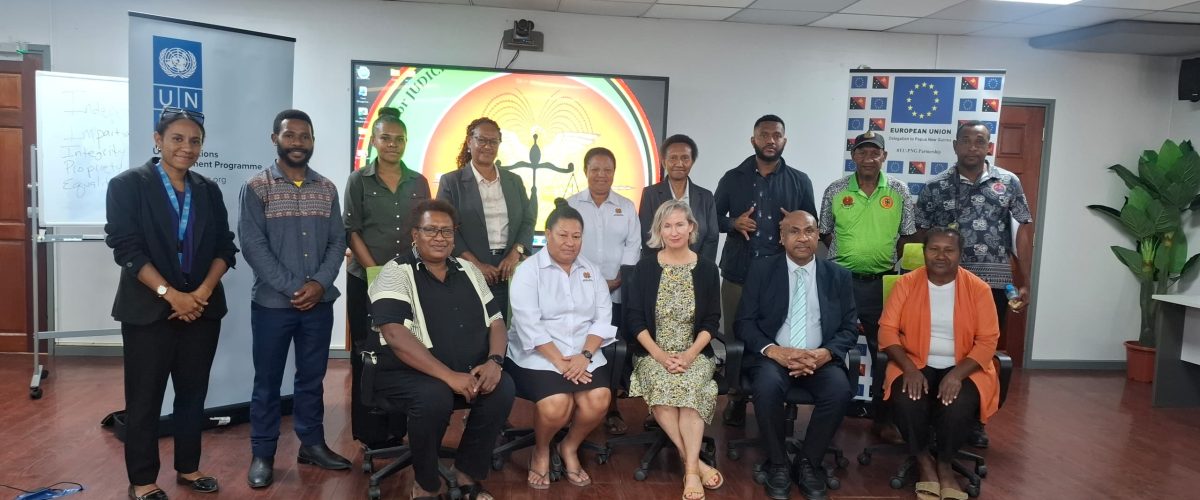
The United Nations Development Programme (UNDP), in partnership with the Papua New Guinea Centre for Judicial Excellence (PNGCJE), convened a workshop on Judicial Integrity and Gender-Based Violence from a Criminal Justice Perspective on 20 August 2026 in Port Moresby, bringing together justice sector practitioners to strengthen ethical decision-making and integrity in the handling of gender-based violence cases.
The workshop brought together court staff from across the Judiciary, providing an opportunity to strengthen understanding of judicial ethics and accountability in addressing gender-based violence. The training forms part of the European Union-funded Preventing and Countering Corruption in Papua New Guinea Project, jointly implemented by UNDP Papua New Guinea and the United Nations Office on Drugs and Crime (UNODC).
In his opening remarks, Mr Nicholas Mirou, Deputy Executive Director of the PNGCJE, highlighted the critical importance of judicial integrity in maintaining public trust and confidence in the justice system. He underscored the value of continuous professional development for justice sector actors and emphasized that ethical decision-making, fairness, and accountability are essential in ensuring access to justice, particularly for survivors of gender-based violence. Mr Mirou noted that workshops such as this provide an important platform for strengthening understanding of the Bangalore Principles of Judicial Conduct and promoting a justice system that is responsive, transparent, and trusted by all Papua New Guineans.
The workshop explored the practical application of the Bangalore Principles of Judicial Conduct through a unique case-study approach that followed a single gender-based violence case as it progressed through the criminal justice chain, from reporting and investigation through to trial, judgment, sentencing, and post-trial outcomes.
Facilitated by Ms Emily Patterson, UNDP Consultant, the workshop examined how the six core values of the Bangalore Principles, namely Independence, Propriety, Impartiality, Equality, Competence and Diligence, and Integrity, are tested at different stages of the criminal justice process. Through interactive discussions and peer learning, participants reflected on the ethical challenges faced by police officers, prosecutors, defence counsel, judges, and court officials in handling gender-based violence cases.
The training was designed to move beyond theoretical discussions by demonstrating how ethical decisions made at one stage of the justice process can influence outcomes throughout the entire system. Participants examined issues such as investigating allegations involving influential individuals, addressing community and societal pressures, avoiding harmful myths and stereotypes, maintaining fairness in courtroom proceedings, and ensuring public confidence in judicial decisions.
Among the key objectives of the workshop were building a practical understanding of the Bangalore Principles, promoting dialogue across the criminal justice chain, encouraging peer learning on ethical challenges, and strengthening the handling of gender-based violence cases through a judicial integrity lens.
Participants left the workshop with an enhanced understanding of how integrity is tested through everyday decisions, stronger skills in identifying and responding to ethical dilemmas, and a greater appreciation of the role each justice sector actor plays in fostering public confidence in the justice system.
The workshop was organized by UNDP Papua New Guinea and the PNGCJE under the European Union-funded Preventing and Countering Corruption in Papua New Guinea Project, reaffirming the partners’ shared commitment to strengthening judicial integrity, promoting accountability, and enhancing public trust in justice institutions throughout Papua New Guinea