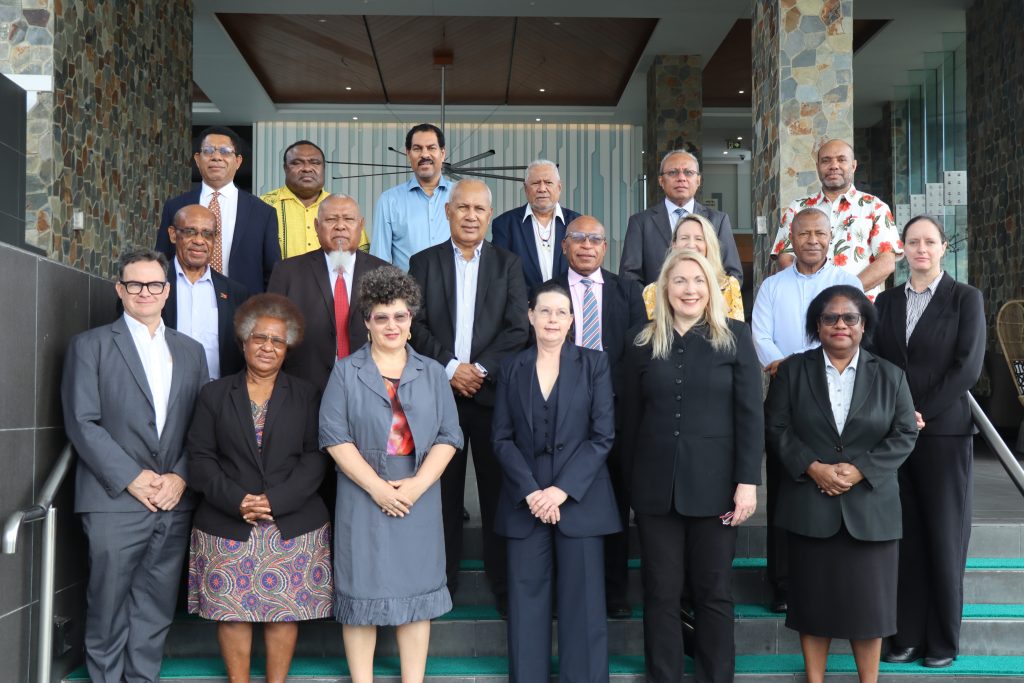
Seventeen judges from the Supreme and National Courts of Papua New Guinea successfully completed a one-and-a-half-day Maritime and Admiralty Law Training held at Loloata Island Resort on 23–24 June 2026. The program was hosted and funded by the Papua New Guinea Centre for Judicial Excellence (PNGCJE).
Justice K Allen David CMG delivered the opening address, emphasizing the importance of strengthening judicial expertise in maritime law for Papua New Guinea. In his remarks, he welcomed Honourable Judges, distinguished colleagues, esteemed guests, and facilitators, highlighting the nation’s deep connection to the sea and the growing significance of maritime jurisprudence.
He expressed gratitude to lead facilitator Justice Sarah Derrington, Judge of the Federal Court of Australia, and co-facilitator Justice Berna Collier, Judge of the Federal Court of Australia and Judge of the Supreme and National Courts of Papua New Guinea. He also acknowledged the contributions of PNG regulatory authorities, whose involvement ensured that discussions remained grounded in the realities of maritime governance and enforcement.
Justice David commended PNGCJE for organizing and coordinating the program, noting that judicial education initiatives were vital to building competence and improving access to justice for the people of Papua New Guinea.
Over the course of the training, participants examined a wide range of topics, including international obligations, regulatory frameworks, judicial practice, liability and compensation, fisheries, environmental concerns, and enforcement of maritime claims. With 18 judges in attendance, the program represented a significant investment in judicial capacity.
Justice David emphasized that maritime disputes had to be resolved with fairness, clarity, and adherence to international standards, as the sea sustained livelihoods, facilitated trade, and shaped the environment. He encouraged participants to fully engage with facilitators, colleagues, and regulatory authorities, reaffirming the judiciary’s commitment to upholding the rule of law in maritime matters.
Justice Berna Collier, in her remarks, noted Papua New Guinea’s unique position as an island nation with extensive maritime boundaries and a strong dependence on shipping, ports, fisheries, and international trade. She stressed that PNG’s economic and social well-being was closely connected to the sea, and that inevitable maritime activities gave rise to legal disputes requiring specialized judicial knowledge and a sound understanding of admiralty law.
“The purpose of this training is to strengthen our capacity as judges to effectively deal with maritime and admiralty matters, including issues related to jurisdiction, carriage of goods, marine insurance, and the application of international maritime conventions,” Justice Collier said. “It also will provide an opportunity for us to exchange experiences, discuss emerging developments, and promote consistency and excellence in judicial decision-making.”
The Judiciary of Papua New Guinea reaffirmed its commitment to advancing judicial capacity and ensuring that maritime disputes were resolved with fairness and adherence to international standards.