
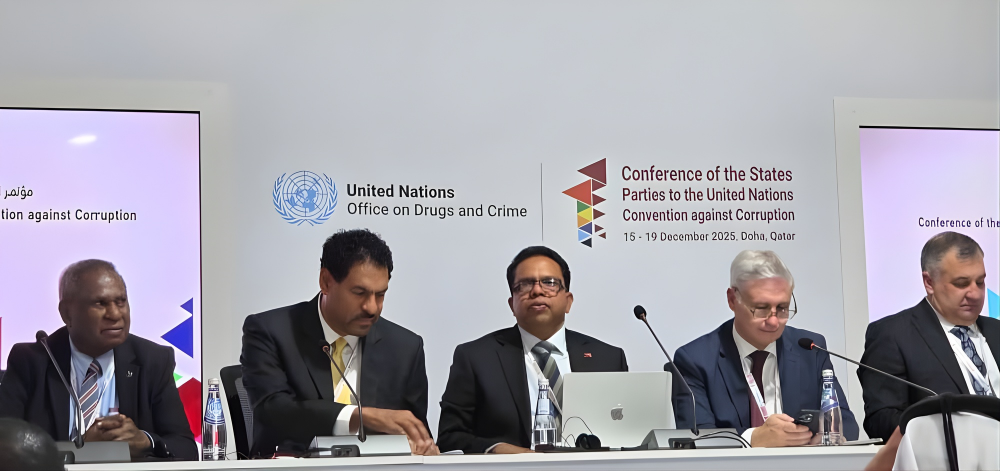
The Judiciary of Papua New Guinea reaffirmed its leadership in advancing judicial integrity and well-being at the Eleventh Session of the Conference of States Parties (COSP11) to the United Nations Convention against Corruption (UNCAC), held in Doha, Qatar from the 15 – 19 December, 2025.
Hosted by the State of Qatar in close coordination with the United Nations Office on Drugs and Crime (UNODC), COSP11 brought together States Parties, signatories, observer states, intergovernmental organizations, civil society, and leading experts in the field of anti-corruption.
The biennial conference served as the Convention’s main policymaking body, providing a strategic platform to assess progress, address emerging challenges, and adopt resolutions shaping global anti-corruption priorities. The session featured plenary meetings, high-level dialogues, special events, and exhibitions designed to foster dialogue, knowledge exchange, and collective action.
The conference was held under the theme “Shaping Tomorrow’s Integrity”, focusing on emerging threats in the fight against corruption and exploring ways to harness AI and new technologies to strengthen international cooperation in combating complex criminal activities.
The Papua New Guinea Judiciary was represented by the Chief Justice, Chief Sir Gibuma Gibbs Salika, Justice John Carey, and Justice Rangajeeva Wimalasena, who each delivered key interventions.
Chief Sir Gibbs Salika highlighted Papua New Guinea’s pioneering role as the first Pacific nation to ratify UNCAC in 2007. He outlined national reforms including the Independent Commission Against Corruption (ICAC), a National Anti-Corruption Strategy, and the judiciary’s Fraud and Corruption Track. He emphasized that judicial well-being is now a core integrity reform, noting that stressed or vulnerable judges risk compromised impartiality.
Justice Carey presented domestic initiatives such as annual Judges Wellness Day, wellness retreats, work-life balance training, and improved access to medical services. He announced resolutions providing free medical clinics, subsidized health insurance, and incentives for fitness activities.
Justice Wimalasena highlighted the global impact of the Nauru Declaration on Judicial Well-being (2024) and the UN General Assembly’s proclamation of 25 July as the International Day for Judicial Well-being in 2025. He introduced the Global Judicial Well-being Research Hub and announced PNG’s commitment to establish a Judicial Well-being Secretariat to lead global initiatives, including drafting a Commentary to the Declaration.
Papua New Guinea’s Judiciary pledged to continue leading reforms that place integrity and well-being at the heart of justice, setting an example for the Pacific and beyond.